
"Fliegeruhr" is German for "pilot's watch," but the term refers to something much more specific than any watch a pilot might wear. It describes a family of large, high-legibility cockpit instruments developed for German aviators in the 1930s and '40s. The design has barely changed since, because it never really needed to. Here's what actually makes a Flieger a Flieger, and how to choose between the two classic dial styles.
A Brief History of the B-Uhr
In the late 1930s, the German Air Ministry (RLM) commissioned an observation watch, the Beobachtungsuhr, or "B-Uhr", for use by navigators on long-range flights, where precise, easy-to-read timing was a matter of life and death for dead-reckoning navigation. Five manufacturers were approved to build it to spec: A. Lange & Söhne, IWC, Wempe, Stowa, and Laco. Every B-Uhr from those five shared the same core layout, because the design brief left almost no room for stylistic variation. Form followed function, strictly.
What Makes a Watch a "Flieger"?
A true Flieger, whether vintage or modern, tends to share a specific set of design features, all inherited directly from the original B-Uhr spec:
- Oversized case: Originals ran 55mm so they could be read at a glance while wearing thick flight gloves; modern versions are usually 40-45mm.
- Onion crown: A large, bulbous crown, again sized for gloved hands.
- High-contrast dial: Matte black dial with painted white or cream numerals and a prominent triangle-with-two-dots at 12 o'clock, so the top of the dial is identifiable instantly.
- Blued steel hands: Sword-shaped, oversized, and lumed for night navigation.
- Minimal branding: Original B-Uhrs carried almost no maker markings on the dial — legibility came first.
Type A vs. Type B Dials
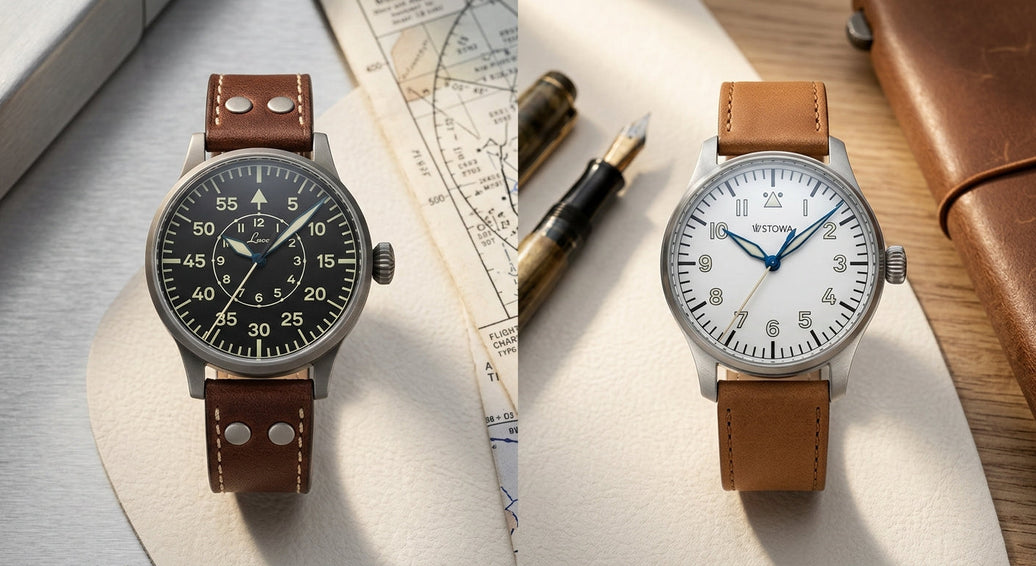
Nearly every modern Flieger, including reissues from Laco, is built around one of two original dial layouts. Knowing the difference is the fastest way to figure out which style actually suits how you read a watch.
Type A Dial
The original, simpler layout: Arabic numerals 1 through 12 running around the full dial, with minute markers along the outer track. It's the more "classic" pilot-watch look and the one most people picture when they hear "Flieger."
Type B Dial
Introduced slightly later for navigators who needed to read elapsed minutes faster than hours: the minute track and numerals 1-60 are pushed to the outer edge of the dial, while the hour numerals 1-12 are moved inward to a smaller inner ring. At a glance it looks busier, but it's arguably faster to read minutes off of, which was the entire point.
Case Size and Wearability
Modern Flieger watches are typically offered in a range of sizes rather than the original's 55mm, which makes them far more wearable day to day:
- ~39-40mm: The most versatile size for smaller wrists or anyone who wants the Flieger look without the vintage-scale presence.
- ~42mm: The sweet spot for most wrists. It's big enough to feel like an instrument, not so big that it dominates a thin wrist.
- ~45mm and up: Closer to the original spec, and genuinely worth trying on first if you haven't worn something that large before.
Choosing Your First Flieger
If you're deciding between styles, it usually comes down to two questions: do you prefer the cleaner Type A look, or the more technical Type B layout, and do you want a case size closer to the original 55mm instrument or something sized for daily wear? There's no wrong answer. The whole appeal of the Flieger is that the formula has stayed useful for nearly ninety years, so any well-built version of it will still do exactly what it was designed to do. Laco's current lineup covers both dial types across several case sizes, which makes it a reasonable place to compare them side by side before deciding.
FAQ
What's the difference between a Flieger and a regular field watch?
Field watches prioritize rugged simplicity for ground use; Fliegers are specifically optimized for at-a-glance legibility in a moving cockpit, which is why they run larger with a busier, higher-contrast dial and an oversized crown built for gloved hands.
Why do Flieger watches have that triangle at 12 o'clock?
It's a holdover from the original B-Uhr spec — a triangle flanked by two dots at 12 o'clock lets a navigator instantly locate the top of the dial without needing to read numerals first, even in low light or under stress.
Is Type A or Type B more historically "correct"?
Both are historically correct — Type A came first, and Type B was developed afterward for navigators who specifically needed faster minute-reading. Neither replaced the other; manufacturers built both depending on the intended use.
Are modern Laco watches actually connected to the WWII-era B-Uhr?
Yes. Laco was one of the five original manufacturers approved to build the B-Uhr under the RLM specification, and the company has continued making pilot watches based on that same design lineage ever since.













Leave a comment