
If you've spent any time in flieger watch forums, you've hit this debate eventually: Laco or Stowa? Both are German brands with real ties to the original WWII-era B-Uhr pilot watches, both make excellent budget-to-mid-range fliegers, and both show up constantly in "which pilot watch should I buy" threads. They're often cross-shopped by the same buyer, which makes the differences between them worth understanding before you spend $300-$600 on one.
A shared history, two different paths
Both brands trace back to the same military spec. The original B-Uhr (Beobachtungsuhr, or "observation watch") was built to a strict Luftwaffe standard in the late 1930s and early 1940s. It had an oversized case, onion crown you could operate with gloves on, and a dial designed to be read at a glance in a cockpit. Five manufacturers originally built to that spec, and Laco and Stowa were both among them, with Laco (then Lacher & Co.) producing thousands of units for the German air force during the war.
That shared origin is why both brands' modern fliegers look so similar with their big case, railroad minute track, cathedral or breguet hands, minimal dial text. But the two companies took different approaches to translating that history into a modern lineup, and that's where the real differences show up.
Case and build quality
This is where owners who've had both tend to land closest to a consensus: it's close, with a slight edge to Stowa on finishing. Stowa's cases and crowns are generally considered a step more refined with tighter tolerances, a crown that feels more substantial in the hand.
Laco doesn't lose this comparison by much, though, and it wins on a couple of specific points:
- Lug-to-lug length. Laco's cases tend to run a bit shorter lug-to-lug for a similar case diameter, which matters if you have a smaller wrist and still want the oversized flieger look.
- Case shape under close inspection. Several long-time owners note the case lines and hand finishing photograph better on Laco in macro shots. It's a small thing, but it adds up if you're the type who checks a watch closely.
Neither brand is going to disappoint you on build quality at this price point. This is a "which flavor of very good" comparison, not a "one of these is bad" one.
Dial legibility and design feel
Legibility is the entire point of a flieger dial, and both brands nail the fundamentals: high-contrast railroad track, big luminous numerals, a hand set you can read in a half-second glance. Where they diverge is overall character.
Stowa's fliegers tend to read as the dressier option of the two with cleaner proportions, a slightly more restrained overall presence on the wrist. Laco leans a bit more toward the rugged, tool-watch end of the spectrum, with case and dial details that feel closer to the WWII original. Neither is objectively "more correct". It comes down to whether you want your flieger to double as a dress-casual piece or stay firmly in tool-watch territory.
Movement and value
This is the category where Stowa usually pulls ahead on paper. Stowa fliegers commonly ship with a higher-grade movement for a comparable price point than Laco's equivalent tier which is a real, measurable difference if movement spec is high on your priority list.
That said, value isn't purely a movement-grade contest. Laco's pricing across its range tends to undercut Stowa slightly at a given feature set, and if historical pedigree matters to you-actual WWII production lineage versus a strong but comparatively later entry into flieger watchmaking-that's a point in Laco's favor that doesn't show up on a spec sheet.
So which one should you actually buy?
Neither brand is a wrong answer here. That's the honest summary of most long-term owner comparisons. But a few questions can point you toward the right one:
- Want the strongest direct link to WWII flieger history? Lean Laco.
- Prioritizing movement grade and finishing above all else? Lean Stowa.
- Smaller wrist, want the big-flieger look without the long lug-to-lug? Lean Laco.
- Want your flieger to pull double duty as a slightly dressier piece? Lean Stowa.
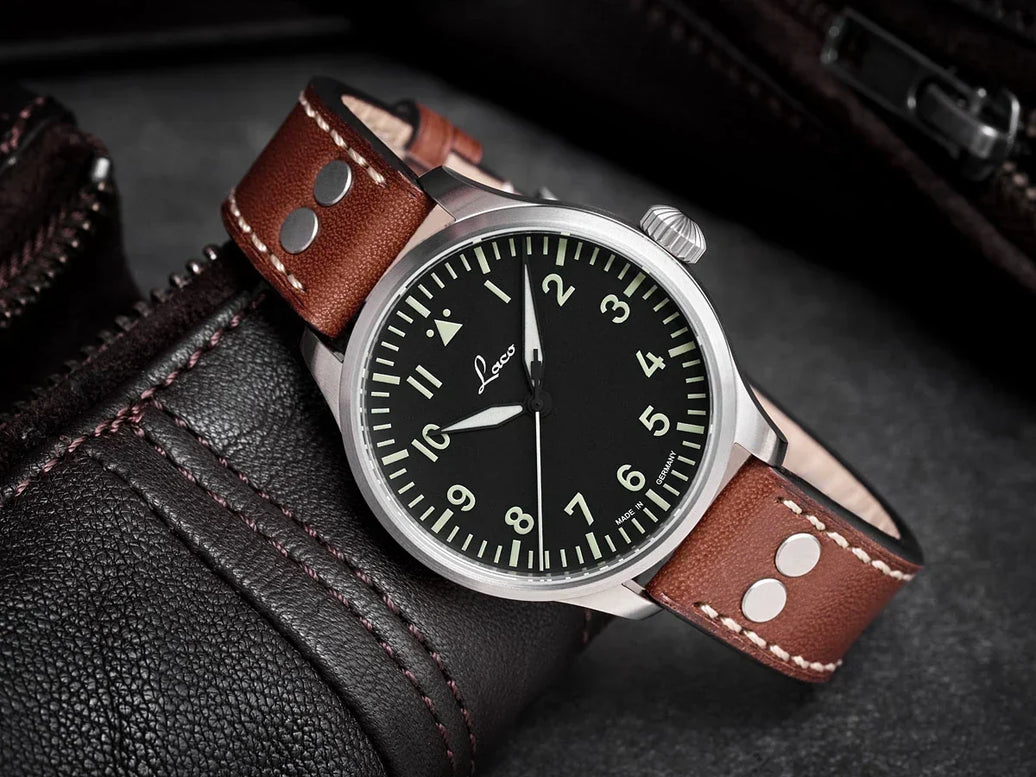
If you're leaning Laco, it's worth handling a few references side by side before deciding. The line spans several case sizes and dial treatments, from the 39mm Wien and Valencia up to the 42mm Aachen, and the differences in proportions matter more than spec sheets suggest. You can see our current Laco lineup here.
Shop German Pilot Watches
Ready to compare the real-world options? Browse the Laco collection for authentic German Flieger watches across hand-wound, automatic, and modern tactical styles.
FAQ
Are Laco and Stowa actually the same watch with different names?
No. They're separate companies with separate manufacturing, and while their fliegers share a design language rooted in the same military spec, the case construction, movements, and finishing are distinct between the two brands.
Which brand has more historical credibility?
Laco has the stronger direct wartime lineage — it was one of the original five manufacturers producing B-Uhr watches for the German air force in the 1940s, with thousands of units built under that contract.
Is a Laco or Stowa a good first flieger watch?
Yes, both are commonly recommended as first fliegers. They're well-built at their price points, easy to service, and give you the genuine oversized-case, high-legibility experience the style is known for without the premium price tag of boutique flieger makers.
Do these watches run big?
Fliegers are traditionally oversized by design, and both brands' larger references (40mm+) wear accordingly. Both offer smaller case options if the classic 42-44mm flieger size isn't for you.














Leave a comment