
Movement Tier Benchmark: Standard vs. Élaboré vs. Top vs. COSC
| Spec / Feature | Standard Grade | Élaboré (Special) Grade | Top (Premium) Grade | Chronometer (COSC) |
| Testing Positions | 2 Positions (Dial Up, 6H) | 3 Positions (Dial Up, 6H, 9H) | 5 Positions | 5 Positions (Official ISO 3159) |
| Average Daily Rate | +/- 12 sec/day | +/- 7 sec/day | +/- 4 sec/day | -4 / +6 sec/day |
| Max Daily Variation | +/- 30 sec/day | +/- 20 sec/day | +/- 15 sec/day | COSC Certified Criteria |
| Balance Wheel | Gilt Nickel | Gilt Nickel | Glucydur (Beryllium Bronze) | Glucydur |
| Hairspring | Nivarox 2 | Nivarox 2 | Anachron | Anachron |
| Shock Absorber | Novodiac / Etachoc | Novodiac / Etachoc | Incabloc |
If you've shopped for a microbrand automatic, you've seen "Élaboré grade movement" sitting in a spec list like it's self-explanatory. It sort of is, but the word is stricter than it looks, and a lot of watch brands using it are borrowing someone else's vocabulary to describe their own, differently-named product. Here's what the term actually covers, and where it gets stretched.
The Four Grades That Actually Exist At ETA
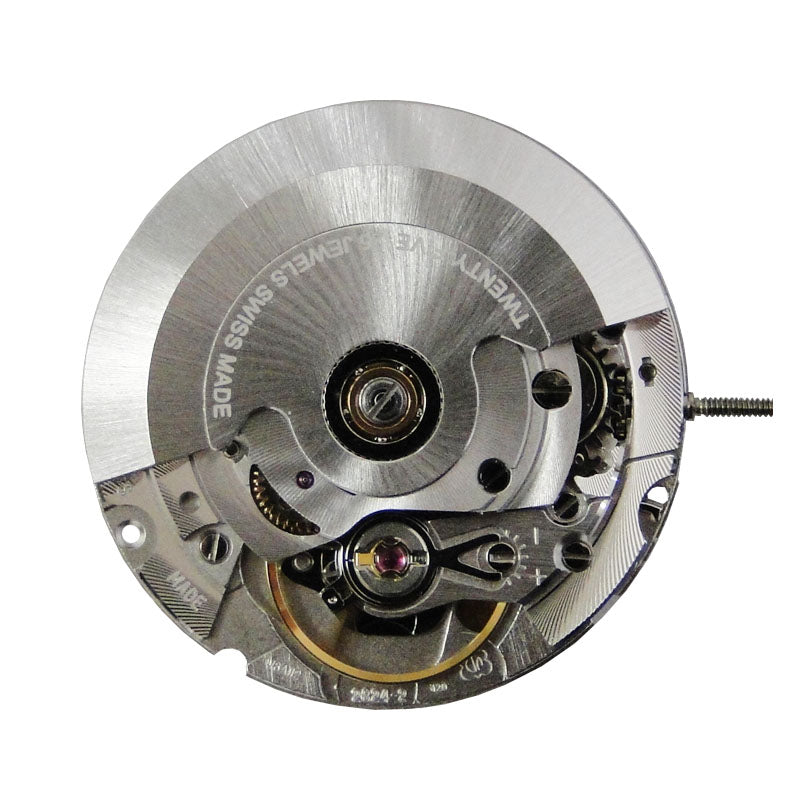
ETA, the Swatch Group's movement arm and maker of the ubiquitous 2824-2, sells its automatic calibers in four official grades: Standard, Élaboré, Top, and Chronomètre. Each step buys you something specific and measurable:
- Standard: adjusted in 2 positions, accuracy of roughly ±12 to ±30 seconds/day, Novodiac shock protection, nickel balance wheel.
- Élaboré: adjusted in 3 positions, ±7 to ±20 sec/day, same Novodiac shock system and polyruby pallet jewels as Standard.
- Top: adjusted in 5 positions, ±4 to ±15 sec/day, upgraded to Incabloc shock protection, a Glucydur balance wheel, and red-ruby pallets.
- Chronomètre: COSC-certified, the only grade independently verified outside the factory.
What stays identical across all four: diameter, height, jewel count, frequency, and power reserve. You're paying for tighter regulation and better components, not a different movement. If you want the deeper physics of what "adjusted to 3 positions" actually buys you over 2, we broke that down fully in our guide to regulation vs. adjustment.
Sellita's Real Names Are Different and Élaboré" Is Borrowed Language
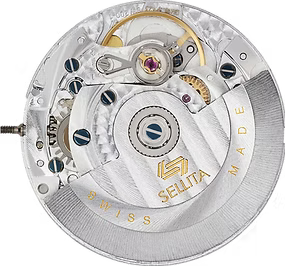
Here's the part most spec sheets skip: Sellita, the Swiss manufacturer behind the SW200-1 that's become ETA's most common substitute, does not call its grades "Élaboré" or "Top." Sellita's actual four-tier lineup is Standard, Special, Premium, and Chronometer. "Special" is the direct equivalent of ETA's Élaboré with the same 3-position adjustment, same ±7 to ±20 sec/day window, but it isn't Sellita's name for it.
Brands and retailers relabel Sellita's "Special" as "Élaboré" and "Premium" as "Top" because ETA's terms are the ones collectors already recognize. It's a real equivalence, not a lie, but it means a listing that says "Sellita Élaboré grade" is using unofficial marketing shorthand rather than quoting Sellita's own catalog. Marathon's GSAR runs on a Sellita SW200-1, which we go deeper on why that specific movement has earned its reputation in our full case for the SW200.
Grades Are a Starting Point, Not a Guarantee
Brands can and do customize an ebauche after it leaves the factory floor. A documented example: Maurice Lacroix's caliber ML115 ships as a Sellita Special ("Élaboré") grade but was fitted with an Incabloc shock system which is normally reserved for Premium/Top instead of the standard Novodiac. Nobody's sure if that came from a special order to Sellita or a modification Maurice Lacroix made afterward, and that ambiguity is common enough that watchmakers consider brand transparency about ebauche sourcing spotty at best.
COSC chronometer certification sits outside this whole internal tier system entirely due to it's independent third-party testing, not a grade a manufacturer assigns itself, and only about 3% of Swiss watch production carries it.
Not Every Movement Even Plays This Game
The Standard/Élaboré/Top/Chronomètre ladder is a Swiss ebauche convention. It doesn't apply to Japanese movements like the Seiko NH35 that power a lot of Islander's lineup, which ship as a single spec rather than a graded family. That's a different value proposition, not a worse one. We compared the two philosophies directly in Seiko NH vs. Miyota: What's the Real Difference?
The practical takeaway: when a spec sheet lists a grade, ask for the position count and the accuracy tolerance in seconds per day, not just the tier name. The name alone has been inconsistently applied across enough of the industry that it's a starting point for a conversation, not the end of one. If you want to see a well-regarded Élaboré-equivalent movement in person, Marathon's GSAR collection is built on exactly this Sellita SW200-1 spec.
Frequently Asked Questions: Élaboré Grade Movements
Q: What is the difference between an Élaboré grade movement and a Standard grade movement?
A: The primary difference comes down to positional regulation and daily accuracy tolerances. A Standard grade movement is adjusted from the factory in only 2 positions (Dial Up and 6 o'clock) with an average daily rate of +/- 12 seconds per day. An Élaboré grade movement is regulated in 3 positions (adding 9 o'clock) to significantly reduce positional error, tightening average daily accuracy to +/- 7 seconds per day.
Q: Does an Élaboré movement use better physical materials than a Standard movement?
A: Mechanically, Élaboré and Standard grades share similar core hardware, such as Nickel balance wheels and Nivarox hairsprings. The step up in material quality happens when moving from Élaboré to Top grade, which replaces the Nickel balance wheel with Glucydur (a thermally stable Beryllium-Bronze alloy) and upgrades the hairspring to Anachron. However, Élaboré movements frequently receive higher aesthetic finishing (such as Perlage or Côte de Genève on the rotor) compared to raw Standard movements.
Q: Why does "Positional Adjustment" matter so much in daily wear?
A: Gravity affects a watch's balance wheel differently depending on how your wrist is oriented. When you are typing at a desk (Dial Up), walking with your hands at your side (3H/9H), or driving (6H), gravity drags on the balance wheel pivots in unique ways. A movement adjusted in 3 positions (Élaboré) compensates for these shifts much better than a 2-position Standard movement, ensuring your watch doesn't gain 15 seconds while typing and lose 10 seconds while walking.
Q: What is the difference between ETA's "Élaboré" and Sellita's "Special" grade?
A: They are direct functional equivalents. ETA uses the terms Standard, Élaboré, Top, and Chronometer. Sellita uses Standard, Special, Premium, and Chronometer. Many watch brands using Sellita SW200-1 or SW300-1 movements will still refer to them as "Élaboré grade" in their product listings because collector communities are more accustomed to ETA's historical terminology.
Q: Can a watchmaker regulate a Standard movement to perform like an Élaboré?
A: Yes, a skilled watchmaker can fine-tune the index regulator arm on a Standard movement to achieve near 0-second error in one static position. However, because a Standard movement was not factory-adjusted across 3 positions, it will still experience wider accuracy swings when you move your wrist into different orientations throughout the day compared to a factory-regulated Élaboré movement.


















Leave a comment